Attending a press check: what to look at on the press sheet and how to sign off a large print run
What a press check is and when it is worth attending
A press check is the moment you stand next to the press, look at freshly printed sheets and approve them before the full run continues. For a large brochure, a packaging job, a high-value catalogue or anything where brand colour really matters, it is the last chance to catch a problem before thousands of copies are printed.
Not every job needs one. For routine reprints, internal documents and jobs that already have an approved contract proof, the printer's own quality checks are usually enough. But for a first run of new packaging, a launch campaign or artwork with critical colour, attending a press check gives you control and gives the press crew a clear target. This guide explains what happens at a press check, what to look at on the press sheet and how to sign off without slowing the job down.
Before the press check: prepare properly
A press check goes much more smoothly when everyone agrees on the target beforehand.
- Bring the approved proof. A colour-accurate contract proof is the reference the press is trying to match. Our article on contract proofs, hard proofs and press proofs explains what each kind of proof is for.
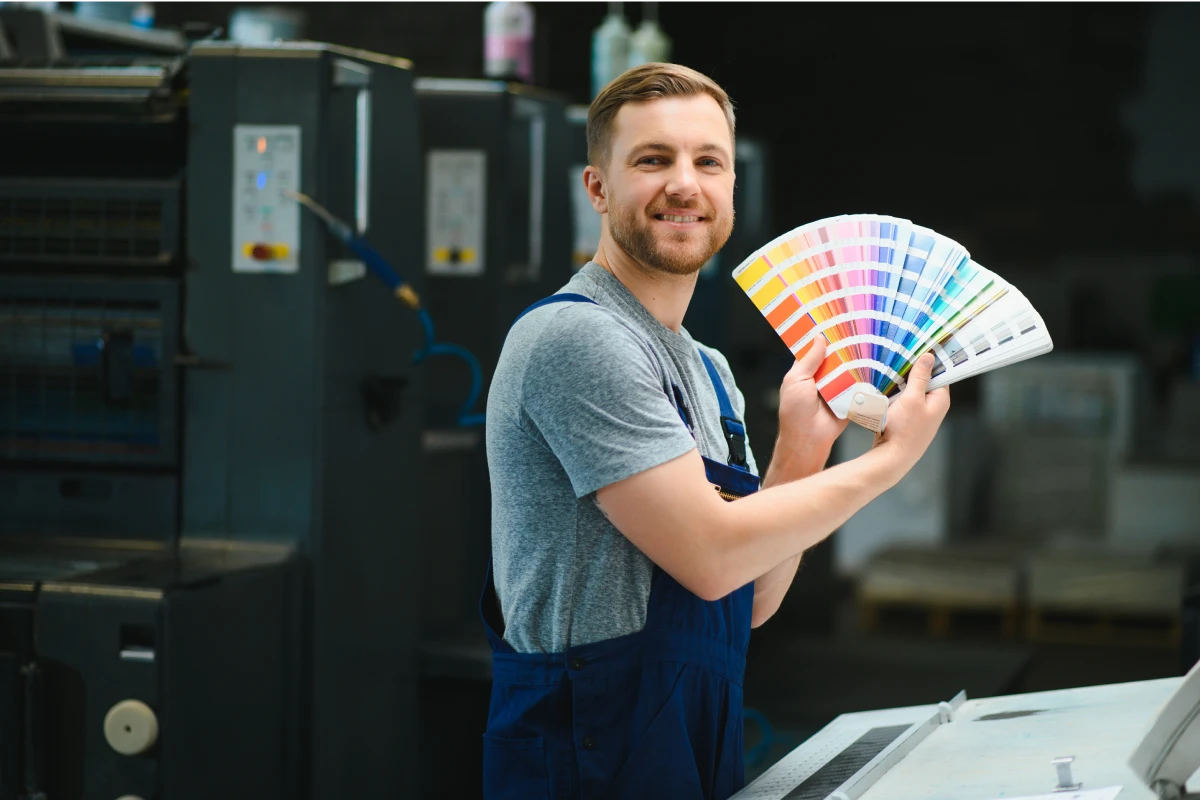
- Bring brand references. Previous printed pieces, Pantone swatches or physical product samples help if colour matching to a brand is critical.
- Know who can decide. The person at the press check should be able to approve the sheet. Calling a manager for every decision stops the press and adds cost.
- Confirm timing. Presses run to schedules. Ask when your job is expected on press and be available. If the press is waiting for you, the make-ready time adds up.
What happens at the press
When you arrive, the press crew will already have mounted the plates and run make-ready sheets to bring ink density and registration into range. They then pull a sheet for you to check, usually under a viewing booth with standard lighting. Standardised lighting matters, because colour looks different under office lights, daylight and warehouse lamps.
You compare the sheet to the proof, make comments, and the crew adjusts. This can take a few rounds. When you are happy, you sign the sheet. That signed sheet becomes the reference for the rest of the run, and press operators pull and compare sheets against it as printing continues.

What to look at on the press sheet
A structured approach helps. Work through the sheet in the same order every time.
Colour
- Key brand colours. Compare logos and brand colour areas to the proof and swatches first.
- Skin tones and food. People notice when faces look grey or red, and when food looks unappetising.
- Neutral greys. Grey areas show colour casts quickly. A grey that leans green or magenta signals a balance problem.
- Consistency across the sheet. Look at the same colour on the left and right of the sheet. Ink keys control colour across the sheet width, so areas can drift.
Remember that adjusting one colour affects everything in the same ink zone. If a brand red sits next to a photo, making the red stronger may also change the photo. The press operator can explain those trade-offs.
Registration
Check that colours line up. Look at fine type in colour, thin lines and the edges of images. Misregistration shows as colour fringes or blurry text. Registration marks and colour bars on the sheet margins help. Our guide to registration and colour bars explains what operators read from them.
Defects
Scan the sheet for hickeys (small spots with a halo), streaks, banding, ghosting or patches where ink coverage looks uneven. Our article on mottle, ghosting, banding and hickeys explains common causes.
Content
A press check is not the time for proofreading, because changing text now means new plates. Still, take a quick look for anything that clearly went wrong between the proof and the plate: a missing image, a font substitution, or an element moved to the wrong page.
Things that cannot be judged at the press
- Finished colour after coating. Varnish and lamination change how colour looks. A wet sheet will also look slightly different when dry.
- Folding and trimming. You are looking at a flat press sheet. Page order, folding accuracy and trim alignment are checked later in finishing.
- Set-off and drying. Ink needs time to dry. Ask the printer how long the stock needs before it can be finished.
If these matter, ask to see a finished sample from the first part of the run, or arrange to inspect a few copies after finishing.
How to give useful comments
The press crew will understand specific requests better than vague ones. "Make it pop" is hard to act on. Try instead:
- "The red in the logo should be a little warmer, closer to the swatch."
- "The faces on page 4 look slightly grey compared to the proof."
- "The blue background is darker on the right of the sheet than on the left."
Ask the operator what is possible within ink tolerances. Some differences between a proof and a press sheet are normal, especially on uncoated stock. Our guide on print run quality control and tolerances explains what level of variation is expected.
Signing off the sheet
When colour, registration and the sheet overall look right, you sign the press sheet, usually with the date and time. The press crew keeps it at the press as the target for the run. During the run they pull samples and compare them to your signed sheet to keep colour consistent from start to finish.
Do not sign a sheet you are not happy with just to save time. Equally, avoid chasing tiny differences that will not be visible in the finished piece. A good press check ends with a sheet you would be happy to see on every copy.
Press checks on multi-sheet jobs
A booklet or catalogue is often printed on several press sheets, each carrying a different group of pages. Each sheet usually needs its own approval, and they may run hours or even days apart. Agree with the printer in advance which sheets you want to see. Often the cover, the sheets with key product photos and the first text sheet are enough, with the remaining sheets matched by the press crew to the signed ones. Bring a list of page numbers that matter most, so you can find them quickly on an imposed sheet where pages appear upside down and out of order.
Remote press checks
If you cannot attend in person, some printers offer remote approval: the operator pulls a sheet, photographs it in a viewing booth, or couriers a signed sheet for your approval. Photos are useful for checking content and obvious problems, but not for judging fine colour accuracy. For colour-critical work, attending in person or relying on a contract proof is still the safer option.
Press checks for your print run with us
We welcome press checks for large runs, packaging and colour-critical work. We schedule a time slot with you, prepare the press so the first sheet is close to your approved proof, and give you a viewing booth with standard lighting and a press operator to explain adjustments. Signed sheets stay at the press throughout the run, and we keep a copy on file for future reprints.
Find out more about our production services on our general printing services page, or contact us to plan a press check for your next large run.