Registration, colour bars and the press sheet: what an operator checks while the job runs
A press does not print a job and stop. It prints thousands of sheets an hour, and somebody has to decide, continuously, whether what is coming off the delivery end still matches what was approved. That decision is made from the press sheet, and specifically from the strip of small marks along its edge that customers usually never see because it gets trimmed off.
Knowing what an operator is looking at is useful even if you never stand at a press. It tells you what can be controlled, what cannot, and what a printer means when they say a job is within tolerance.
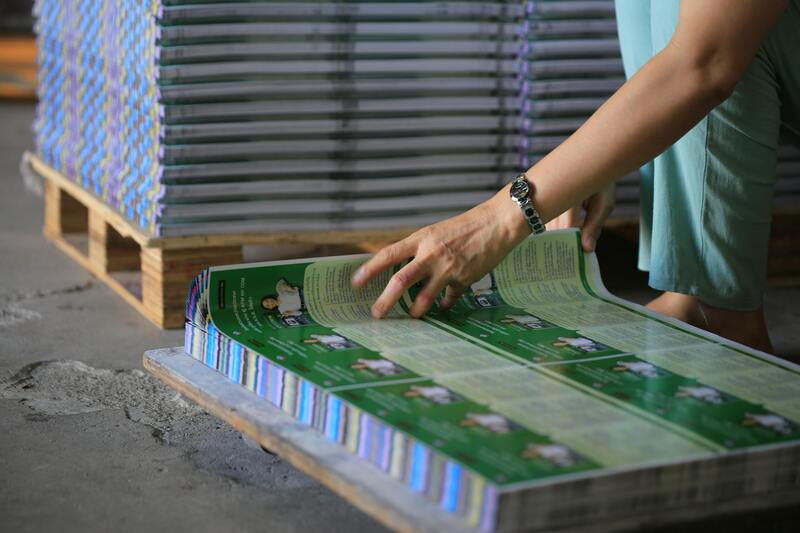
What lives outside the trim
The area beyond your artwork carries the control elements. On a typical sheet you will find:
- Registration marks, small crosshairs printed in every colour, used to check that the four printing units are laying ink in the same place.
- A colour bar, a strip of solid and tint patches for each ink, plus overprints of two and three colours together.
- Trim and fold marks, telling the guillotine and folder where the sheet becomes the finished piece.
- Job identification: order number, sheet name, date, sometimes the plate number.
- Collation or gathering marks on multi-section work, so a bindery can see at a glance if sections are out of order.
None of this survives to the customer. All of it exists so somebody can prove the sheet is right rather than believe it is.
Registration: are the colours on top of each other
Four colour printing lays cyan, magenta, yellow and black separately. If they do not land in the same place, edges fuzz and small text picks up a coloured shadow. Registration marks make that visible: an operator looks at the crosshair through a loupe and sees whether all four rings are concentric.
Commercial registration is usually held to a fraction of a millimetre. Paper is the complicating factor, because it stretches slightly as it takes ink and moisture, and it stretches more across the grain than along it. This is one of several reasons grain direction matters in production planning, as our guide to paper grain direction explains.
Misregistration shows first on small reversed type, where white text sits out of a four colour background. If you are designing work that will be printed conventionally, keeping fine reversed text to a single colour is the practical defence.
The colour bar: measuring instead of guessing
The colour bar is where the job gets numbers attached to it. An operator, or an automatic scanning head, reads the patches and gets several measurements:
Solid ink density tells you how much ink is being laid down. Too little and the image looks weak, too much and shadow detail closes up and drying time increases. Density is the first thing adjusted, because everything else depends on it.
Dot gain, more properly tone value increase, measures how much a halftone dot spreads as it hits the paper. Some spread is unavoidable and expected. Excessive spread darkens midtones and is what makes a printed image look muddier than the proof. Uncoated papers absorb more ink and gain more, which is why the same file looks different on different stocks.
Trapping, measured from the two colour overprint patches, shows how well one wet ink accepts the next. Poor trapping shifts secondary colours: greens go yellow, reds go orange.
Grey balance patches combine cyan, magenta and yellow in proportions that should produce a neutral grey. If that patch has a cast, the whole job has a cast, and it is far easier to see in a grey patch than in a photograph.
Why the operator checks a fresh sheet regularly
Conditions drift over a run. Ink and water balance changes, the blanket picks up paper dust, temperature rises. Pulling a sheet at intervals and reading the bar catches drift before it becomes a rejected pile. On long runs this is sampled continuously by inline scanning; on shorter digital work it is done by eye against an approved sheet.
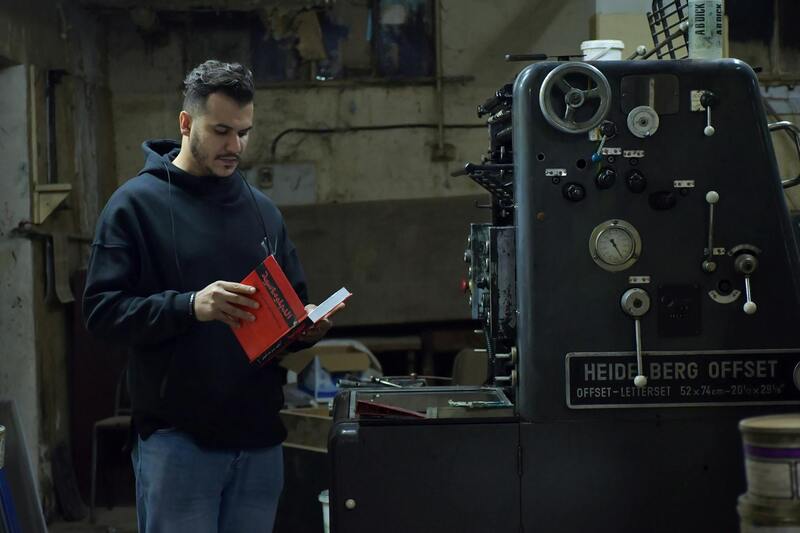
Viewing conditions, which are not a detail
Colour judgement only means something under controlled light. Print viewing uses a standardised daylight condition, around 5000K, in a booth with neutral grey surroundings. The same sheet under warm office lighting looks noticeably different, and under a shop's LED strip different again.
This is worth knowing when you assess a delivery. If you compare a printed piece against a proof beside a window in the afternoon, you are measuring the weather as much as the print. Two samples that match in the booth and disagree under your office lights are showing metamerism, which is a property of the inks and paper rather than an error.
What this means for your job
Three practical conclusions.
First, a printed sheet is held to a tolerance, not to an exact value. Ask what tolerance your printer works to. A reputable answer is specific.
Second, the approved sheet is the reference. If colour matters, ask to approve a press sheet or a contract proof and make clear that the run should match it. Without a named reference, "matching" has no meaning.
Third, most colour complaints trace back to the file rather than the press: wrong colour space, an unexpected spot colour, a heavy total ink coverage that will not dry. Our note on ink drying and set-off covers what happens when coverage is too high, and print run quality control covers what to check on delivery.
Working with us on colour critical print
We run colour bars on every job and keep the readings with the job record, which is what lets us match a reprint to an original rather than starting again. If your work is colour critical, tell us at quoting stage and we will build in a proof and, where it is warranted, a press approval so you sign off on the actual sheet rather than a simulation.
Bring an existing printed sample if you are matching to something, since a physical reference can be measured and a screen cannot. Details of our production capabilities are under general printing services, and if you want to talk through a specification before committing, contact us with the stock and quantity you have in mind.
Frequently asked questions
Can I see a press sheet before the run continues?
On offset work, usually yes, if it is arranged in advance. A press approval means booking press time, so it needs to be scheduled and quoted rather than requested on the day.
Why does the same file look different on two stocks?
Different absorbency changes dot gain, and different paper white changes what the ink sits on. A coated sheet holds the dot and looks more saturated; an uncoated sheet absorbs and looks softer. Both are correct for their material.
What is a reasonable colour tolerance?
Printers typically express it as a delta E value against the approved reference. Ask for the figure and for what happens if the run falls outside it, since the second half of that answer is the one that matters.
Do digital presses use colour bars?
Many do, along with automatic calibration cycles. The principle is the same: measure something known, compare it to a target, and correct before the difference reaches the customer.