Folding methods explained: roll, z-fold, gate and choosing the right one
A fold is a manufacturing step
Designers pick a fold because of how the piece should reveal itself. The folding machine cares about something else entirely: how many times the sheet has to change direction, how thick it gets at the spine, and whether the paper will crack where it bends. When those two views disagree, the job either costs more than quoted or comes back looking slightly wrong.
Most of the disagreement is avoidable, and nearly all of it comes down to two things that get decided at artwork stage. Panel widths, and grain direction.
The folds you will be offered
Half fold
One fold, four pages. The simplest thing a folder can do, and the cheapest. Used for menus, programmes and simple leaflets. Nothing much goes wrong here beyond a fold that misses the centre by a millimetre, which is visible only if you have printed a border.
Roll fold, sometimes called a letter fold
Three panels, six pages, with each panel folding inward on top of the last. This is the standard leaflet that fits a DL envelope. The panel that rolls innermost has to be narrower than the others, usually by 2 to 4mm depending on paper thickness, or the fold bulges and will not sit flat.
Z-fold or concertina
Same three panels, folded in alternating directions so the piece opens out like a fan. Because no panel sits inside another, all three panels are the same width. Concertina continues the pattern across more panels, and works well for timelines or anything read as one continuous spread.
Gate fold
Two outer panels fold inward to meet in the middle, opening like doors onto a full-width centre spread. It has real presentational value for a product launch or a property brochure. The two doors must each be slightly under half the width so they meet without overlapping, and the piece is more sensitive to trimming variance than a simple fold.
Cross fold
A sheet folded once, then again at right angles, giving eight pages from one sheet. Common for maps and instruction sheets. It puts four thicknesses of paper at one corner, so heavy stock is a poor choice here.
Why panel widths are not all equal
This is the detail that produces most reprints on folded work. On any fold where one panel tucks inside another, the inner panel needs to be shorter, because it has to travel around the thickness of the paper it sits inside.
On 130gsm the allowance is small, about 2mm. On 250gsm it is more like 4 to 5mm, and on a six-panel roll fold the allowances stack. Ignore it and the folded piece either will not close flat or the inner panel pokes out past the edge. Design software templates usually build this in, but only if you tell the template the right paper weight.
Two practical habits help. Keep any border or frame away from the fold lines, since a border that runs to a fold shows every fraction of a millimetre of drift. And do not put important text within about 5mm of a fold, because the crease itself distorts the surface slightly and text sitting on it is uncomfortable to read.
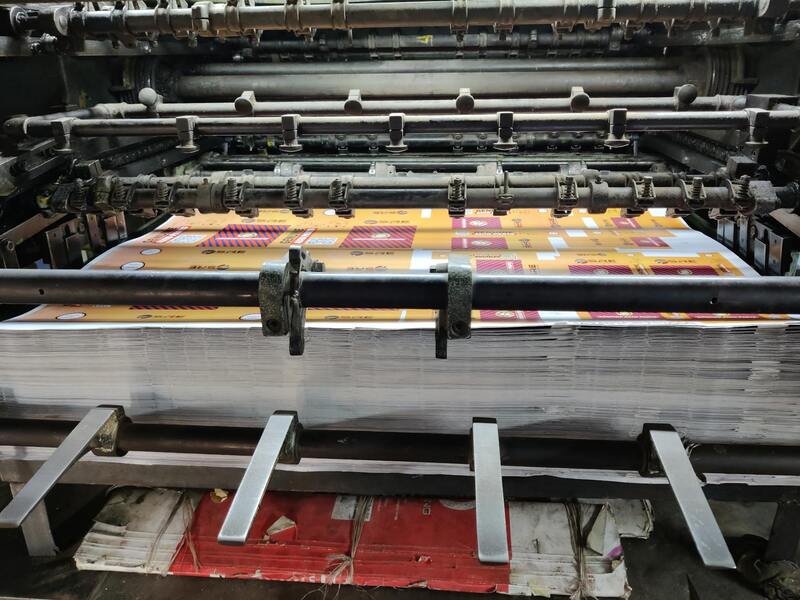
Grain, scoring and cracked folds
Paper has a grain, and it folds cleanly along it and reluctantly across it. Fold across the grain on anything above about 170gsm and the outer surface of the crease stretches, opening small white cracks along the line. On a dark printed area those cracks are obvious.
The fix is to plan the fold to run with the grain from the start, which means specifying the sheet accordingly rather than discovering the problem on the finished job. Our note on paper grain direction goes through how to identify it and why it matters more than most people expect.
Where the grain cannot be helped, scoring does the rest. A score is a crushed channel pressed into the sheet before folding, giving the fibres a defined place to bend. Anything at 200gsm or above should be scored, and anything with heavy ink coverage across the fold should be scored regardless of weight. Laminated stock always needs it, since the film has no give at all.
Where a fold becomes a section
Past a certain page count, folding stops being a finishing operation and becomes the structure of the book. A saddle-stitched booklet is not a stack of pages: it is a set of folded sheets nested inside one another, each one carrying four pages. That is why booklet page counts always come in multiples of four, and why asking for a 14 page booklet produces a polite question rather than a quote.
The nesting has a physical consequence. Each sheet tucked inside the last has to travel a little further around the spine, so the inner pages creep outward toward the fore edge. On a thin booklet this is invisible. On a thick one, or on heavy stock, the inner pages end up measurably narrower after trimming, and a page number sitting close to the outer margin will drift or disappear. The compensation is applied at imposition, and it is covered in creep and page shift.
The practical threshold is around 60 to 70 pages on standard text stock. Above that, the folded spine gets too bulky to staple cleanly and the piece will not stay closed, so the job moves to perfect binding or a wire spine instead. If your page count is climbing during design, it is worth asking early which method it will land in, because the two need different margins.
How folding affects the schedule and the price
Folding is fast when the machine can run the whole job in one pass, and slow when it cannot. A simple half or roll fold on a common stock runs at thousands per hour. A gate fold needs a second pass. Heavy stock needs scoring first, which is another pass. Each pass is setup time plus run time, and setup is the part that does not shrink with quantity.
That has a direct consequence for short runs. On 250 pieces, a fold requiring three passes can cost more than the printing did. On 10,000 the same fold barely registers per unit. If you are ordering a small quantity and the fold is decorative rather than functional, it is worth asking what a simpler fold would save.
Getting a folded job made properly
Send a folding dummy with the artwork, even a rough one. Fold a sheet of paper by hand, number the panels, and mark which face is the front cover. It takes two minutes and removes every ambiguity about panel order, which is the other common source of reprints - artwork laid out in reading order rather than in the order the panels appear on the flat sheet.
- Flat size and finished folded size, both stated
- The fold type by name, plus a dummy or a diagram
- Paper weight, so panel allowances can be checked against it
- Whether the piece has to fit a specific envelope or display holder
- Any lamination, since that decides whether scoring is compulsory
We check panel widths and grain against the stock before the job goes on press, and we will tell you if the fold you have asked for will crack on the paper you have chosen. For multi-page work that goes beyond folding into binding, booklet binding methods covers the next step up, and brochure and booklet printing lists what we run in house.
Send the flat artwork with a folded dummy and we will confirm the panel measurements before anything is printed.